Warm Roof vs Cold Roof Insulation: Which Is Right for Your Loft?
When insulating your loft, you face a fundamental choice between two approaches: warm roof vs cold roof insulation. One insulates at ceiling level, keeping the loft cold; the other insulates between and over the rafters, bringing the loft space into the heated envelope of the house. The right choice depends on how you use your loft, your budget, and whether you plan to convert the space in the future.
What Is Cold Roof Insulation?
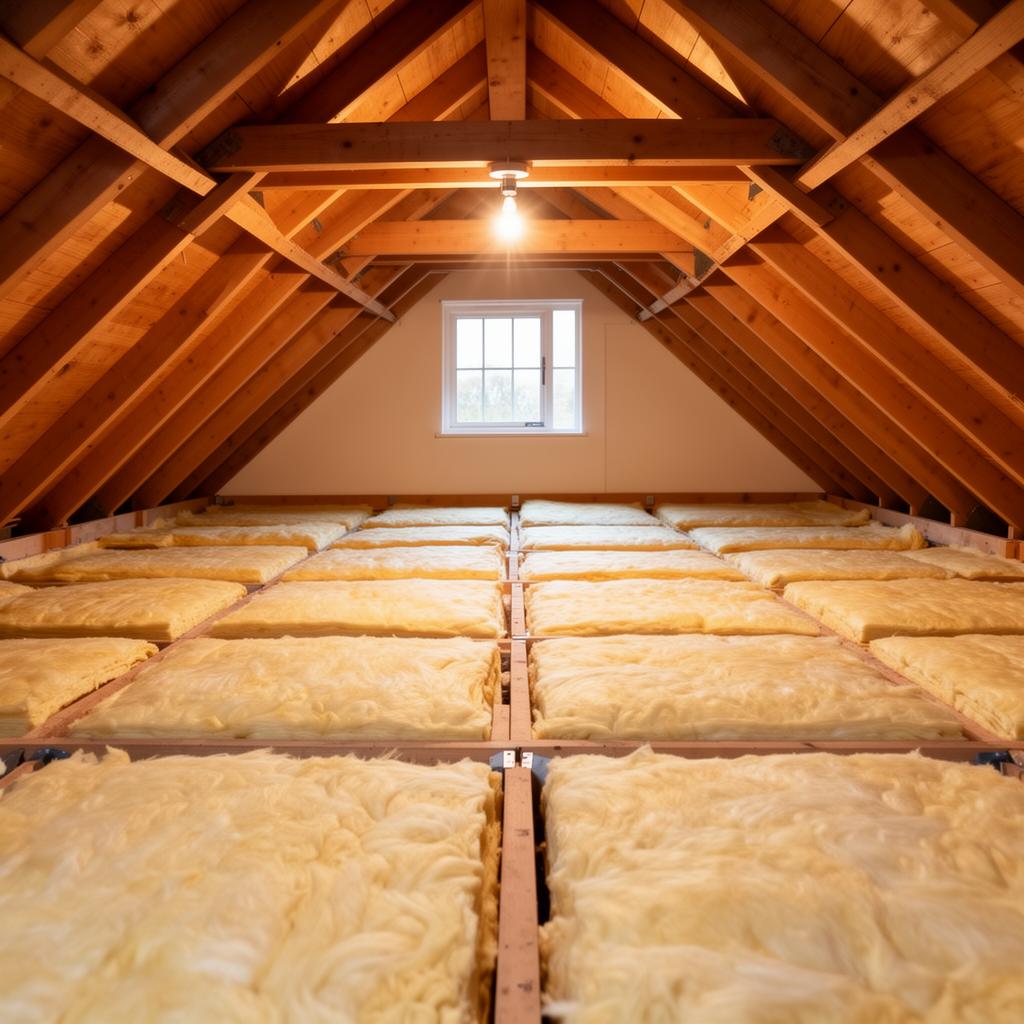
Cold roof insulation is the most common method in UK homes. Insulation is laid horizontally at ceiling level, between and over the ceiling joists. The loft space above remains unheated and ventilated to the outside air.
This is the approach used when you lay mineral wool rolls across your loft floor. The first layer (typically 100mm) fits between the joists, and a second layer (170mm) is laid perpendicular across the top of the joists to reach the recommended total depth of 270mm.
Key characteristics of cold roof insulation include:
- The loft space is cold, typically close to outside temperature in winter
- The roof structure is ventilated through soffit vents, ridge vents, or tile vents
- Water tanks and pipes in the loft must be separately insulated to prevent freezing
- The ceiling joists carry the insulation weight, not the rafters
- Access to the loft for storage is compromised unless raised platforms are installed above the insulation
What Is Warm Roof Insulation?
Warm roof insulation places the insulation at rafter level, either between the rafters, over the rafters, or a combination of both. The loft space is brought inside the heated envelope of the house, meaning it stays warm and can be used as a habitable room.
There are several ways to achieve a warm roof:
- Between rafters: Insulation boards or batts fitted between the rafter timbers, with a ventilation gap maintained above
- Between and below rafters: Insulation between the rafters topped up with an additional layer of insulation board fixed to the underside of the rafters
- Over rafters (sarking): Rigid insulation boards installed above the rafters, beneath the battens and tiles, during a re-roof
- Spray foam: Closed-cell or open-cell spray foam applied directly to the underside of the roof covering between rafters
Warm Roof vs Cold Roof: Detailed Comparison
| Feature | Cold Roof | Warm Roof |
|---|---|---|
| Insulation position | Ceiling level (horizontal) | Rafter level (follows roof slope) |
| Loft temperature | Cold (near outside temp) | Warm (part of living space) |
| Typical U-value achieved | 0.16 W/m2K | 0.16 to 0.18 W/m2K |
| Cost (typical semi-detached) | GBP 300 to GBP 600 | GBP 2,000 to GBP 5,500 |
| DIY feasibility | Yes, straightforward | Possible but more complex |
| Loft usable as room | No (cold and insulation covers floor) | Yes (warm and floor is clear) |
| Storage space | Limited (need raised platforms) | Full loft floor available |
| Water tank protection | Required (tanks will freeze) | Not required (loft is warm) |
| Pipe freezing risk | Yes, pipes must be insulated | No, loft stays above freezing |
| Condensation risk | Low if ventilated correctly | Medium if ventilation gap insufficient |
| Ventilation requirement | Soffit and ridge/tile vents | 50mm gap above insulation between rafters, or none if over-rafter |
When Cold Roof Insulation Is the Better Choice
Cold roof insulation is the right approach in most situations where you simply want to reduce heat loss and energy bills without using the loft as living space.
Choose cold roof insulation when:
- You have a standard loft with good access and no plans to convert it
- Budget is a priority, as cold roof insulation costs a fraction of warm roof
- You want a DIY project, since laying mineral wool rolls is one of the simplest home improvement tasks
- The loft has a standard pitched roof with adequate headroom for installation
- You want to maximise thermal performance, as it is easier to achieve very low U-values with thick horizontal insulation than with insulation constrained by rafter depth
For most UK homeowners who use their loft only for occasional storage, cold roof insulation at 270mm mineral wool is the standard recommendation. The material costs as little as GBP 5 to GBP 8 per square metre, making it one of the cheapest energy efficiency upgrades available.
When Warm Roof Insulation Is the Better Choice
Warm roof insulation is essential for loft conversions and preferable in several other situations.
Choose warm roof insulation when:
- Converting the loft to a habitable room: Building Regulations require the room to be within the heated envelope, which means insulating at rafter level.
- The loft contains water tanks or extensive pipework: A warm roof eliminates the risk of frozen pipes and tanks without needing to insulate them individually.
- You want usable loft storage: The full loft floor area remains available when insulation is at rafter level.
- Re-roofing the property: If the tiles and battens are being replaced, over-rafter insulation can be installed at the same time, combining two jobs.
- The property has a room-in-roof already: Many 1960s and 1970s homes have partially converted lofts that are poorly insulated at rafter level.
Condensation Risks and Ventilation Requirements
Both cold roof and warm roof insulation create condensation risks if ventilation is not handled correctly. However, the risks differ.
Cold roof condensation
In a cold roof, warm moist air from the house below can rise through gaps in the ceiling and condense on the cold underside of the roof covering. The solution is straightforward: ensure the loft is well ventilated so that any moisture is carried away before it can condense. Building Regulations require continuous ventilation at eaves level equivalent to a 10mm gap on two opposite sides for a pitched roof. For roofs with a pitch of 15 degrees or more, additional high-level ventilation at the ridge is also recommended.
You should also ensure there are no gaps in the ceiling that allow moist air to enter the loft. Common problem areas include loft hatches without seals, gaps around downlights, and unsealed pipe or cable penetrations.
Warm roof condensation
In a warm roof with insulation between the rafters, a minimum 50mm ventilation gap must be maintained between the top of the insulation and the underside of the roofing felt or membrane. This gap allows any moisture that passes through the insulation to be carried away by air movement from eaves to ridge.
If the roof has a modern breathable membrane rather than traditional bitumen felt, the ventilation gap requirement may be relaxed, as the membrane allows moisture vapour to pass through to the outside. However, many installers still recommend maintaining the gap as best practice.
A vapour control layer (VCL) on the warm side of the insulation (facing into the room) is essential in warm roof construction to prevent moist indoor air reaching the cold zone behind the insulation.
Warm Roof vs Cold Roof Costs Compared
The cost difference between the two approaches is significant, which is why cold roof insulation remains the default choice for most homeowners.
| Approach | Material Cost (per m2) | Total Cost (typical 50m2 roof) |
|---|---|---|
| Cold roof: 270mm mineral wool DIY | GBP 5 to GBP 8 | GBP 250 to GBP 400 |
| Cold roof: 270mm mineral wool professional | GBP 10 to GBP 15 | GBP 500 to GBP 750 |
| Warm roof: between rafters (mineral wool + PIR) | GBP 30 to GBP 50 | GBP 1,500 to GBP 2,500 |
| Warm roof: between + below rafters (PIR) | GBP 40 to GBP 65 | GBP 2,000 to GBP 3,250 |
| Warm roof: over-rafter (during re-roof) | GBP 60 to GBP 110 | GBP 3,000 to GBP 5,500 |
| Warm roof: spray foam (closed cell) | GBP 35 to GBP 55 | GBP 1,750 to GBP 2,750 |
Over-rafter insulation is the most expensive option but delivers the best thermal performance because it creates a continuous insulation layer with no thermal bridging through the rafter timbers. It only makes economic sense when combined with a re-roofing project.
Loft Conversions: Building Regulations for Warm Roof Insulation
If you are converting your loft into a habitable room, Building Regulations require the roof to achieve a U-value of 0.16 W/m2K. This typically requires a combination of insulation between and below the rafters.
For example, with standard 100mm deep rafters:
- 75mm PIR board between rafters (leaving 25mm ventilation gap above): R-value = 3.41
- 50mm PIR board below rafters: R-value = 2.27
- 12.5mm plasterboard: R-value = 0.06
- Surface resistances: 0.17
- Total R-value: 5.91
- U-value: 1/5.91 = 0.17 W/m2K
To achieve exactly 0.16 W/m2K, you might increase the below-rafter insulation to 62.5mm PIR. Your Building Control officer will confirm the required specification for your particular project.
If you are planning a loft conversion or need advice on the best insulation approach for your roof, Green Reach Energy’s quote-comparison service is launching soon — register your interest and we’ll let you know when you can compare quotes from qualified installers.
Frequently Asked Questions About Warm and Cold Roof Insulation
Can I have both warm and cold roof insulation?
Technically, you should not insulate at both ceiling level and rafter level simultaneously. If you insulate at rafter level (warm roof), you should remove the ceiling-level insulation. Having both creates a stagnant air pocket between the two insulation layers that can lead to severe condensation problems, as moisture becomes trapped with no ventilation path.
Does spray foam count as warm roof insulation?
Yes. Spray foam applied to the underside of the roof tiles or slate between the rafters creates a warm roof. However, spray foam is controversial because it bonds to the roof covering, making future re-roofing more difficult and expensive. Many mortgage lenders and surveyors view spray foam negatively. If you are considering spray foam, be aware of the potential impact on property valuations and future saleability.
Do I need planning permission for warm roof insulation?
Internal warm roof insulation (between or below rafters) does not require planning permission. Over-rafter insulation that raises the roof height might require planning permission if it alters the external appearance or exceeds permitted development limits. If you live in a conservation area or the property is listed, check with your local planning authority before making any external changes.
How thick does warm roof insulation need to be?
To meet the Part L Building Regulations target of 0.16 W/m2K, you typically need 120 to 150mm of PIR insulation or 200 to 250mm of mineral wool. The exact thickness depends on the material’s thermal conductivity and whether it is installed between rafters only or between and below. PIR boards achieve the required U-value in less thickness, which preserves more headroom in a loft conversion.
What happens to water tanks in a warm roof loft?
In a warm roof arrangement, the loft space is heated, so water tanks and pipes no longer need separate insulation against freezing. However, if you are converting the loft to a habitable room, you may need to relocate the cold water tank or switch to a sealed heating system and unvented hot water cylinder that do not require a header tank in the loft.
See what these numbers mean for your home
Free instant estimate — costs, savings, payback and grants for your region.

Related Articles
Home Insulation Costs and Grants: Your Complete 2026 Guide
Update (June 2026): ECO4 closed to new applications in March 2026. Approved installations continue to December 2026. The Warm Homes: Local Grant is now the main funding route for insulation.…
18 May 2026
How to Reduce Condensation and Damp While Keeping Your Home Warm
Learn why condensation forms in UK homes, the difference between condensation and rising damp, and proven ventilation strategies to fix damp without losing heat.
8 May 2026
Conservatory Roof Replacement: How a Solid Roof Cuts Energy Bills and Adds Value
Replacing an old polycarbonate or glass conservatory roof with a solid insulated roof can slash heat loss, cut energy bills and turn a seasonal room into a year-round living space.
6 May 2026