U-Values Explained: What UK Homeowners Need to Know About Insulation Performance
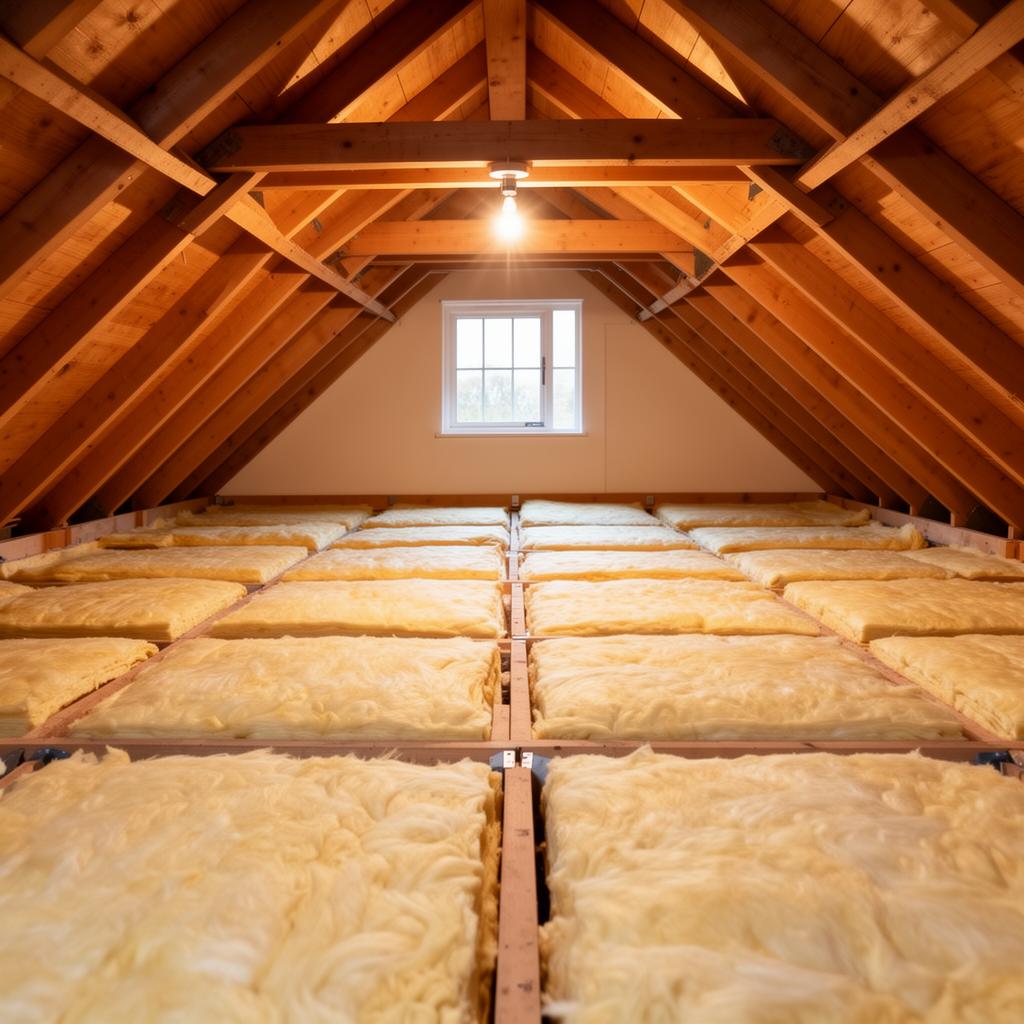
If you have ever read a quote for insulation or looked at Building Regulations, you will have encountered the term U-value. Understanding U-values explained in plain English is essential for any UK homeowner considering insulation improvements, because this single number tells you how effectively a building element resists heat loss. The lower the U-value, the better the insulation, and the less money you spend on heating your home.
What Is a U-Value?
A U-value measures the rate at which heat passes through a building element, such as a wall, roof, floor, or window. It is expressed in watts per square metre per degree Kelvin (W/m2K). In practical terms, it tells you how many watts of heat energy pass through one square metre of the element for every one-degree difference between the inside and outside temperature.
A solid brick wall with a U-value of 2.1 W/m2K loses 2.1 watts of heat per square metre for every degree of temperature difference. If it is 20 degrees inside and 5 degrees outside (a 15-degree difference), each square metre of that wall loses 2.1 x 15 = 31.5 watts. Over a typical semi-detached house with 80 square metres of external wall, that equates to 2,520 watts of continuous heat loss through the walls alone.
The key principle is simple: lower U-values mean less heat loss, better insulation, and lower energy bills.
Part L Building Regulations U-Value Targets
The Building Regulations Approved Document Part L sets minimum thermal performance standards for new buildings and extensions. These targets are expressed as maximum U-values and have become progressively stricter over the decades.
| Building Element | Part L Target (2021 onwards) | Typical Pre-1920 Uninsulated | Typical 1970s Cavity Wall |
|---|---|---|---|
| External walls | 0.26 W/m2K | 2.1 W/m2K | 1.0 W/m2K |
| Roof / loft | 0.16 W/m2K | 2.3 W/m2K | 0.68 W/m2K |
| Ground floor | 0.18 W/m2K | 0.7 W/m2K | 0.7 W/m2K |
| Windows | 1.4 W/m2K | 4.8 W/m2K (single glazed) | 2.8 W/m2K (old double) |
| Doors | 1.4 W/m2K | 3.0 W/m2K | 3.0 W/m2K |
These Part L targets apply to new-build elements and extensions. There is no legal requirement to bring your entire existing home up to these standards, but they represent best practice and are the benchmarks that EPC assessments measure against.
U-Values Explained UK: Before and After Insulation
To understand the practical impact of insulation, it helps to see how U-values change with different upgrades. The following table shows typical before-and-after U-values for common insulation improvements.
| Insulation Upgrade | Before U-Value | After U-Value | Improvement |
|---|---|---|---|
| Solid wall + external insulation (100mm EPS) | 2.1 W/m2K | 0.30 W/m2K | 86% reduction |
| Solid wall + internal insulation (60mm PIR) | 2.1 W/m2K | 0.35 W/m2K | 83% reduction |
| Cavity wall + blown insulation | 1.0 W/m2K | 0.35 W/m2K | 65% reduction |
| Loft: 0mm to 270mm mineral wool | 2.3 W/m2K | 0.16 W/m2K | 93% reduction |
| Loft: 100mm to 270mm mineral wool | 0.44 W/m2K | 0.16 W/m2K | 64% reduction |
| Suspended floor + 100mm mineral wool | 0.70 W/m2K | 0.25 W/m2K | 64% reduction |
| Single to double glazing | 4.8 W/m2K | 1.4 W/m2K | 71% reduction |
| Double to triple glazing | 1.4 W/m2K | 0.8 W/m2K | 43% reduction |
The most dramatic improvements come from insulating elements that currently have no insulation at all. Adding loft insulation to an uninsulated loft reduces the roof U-value by over 90%. This is why loft and cavity wall insulation consistently deliver the best return on investment for UK homeowners.
How to Calculate a Whole-Wall U-Value
A wall is not a single homogeneous material. It is made up of multiple layers, each with its own thermal properties. The U-value of the whole wall assembly is calculated by adding up the thermal resistance of each layer.
Each material has a thermal conductivity value (lambda, measured in W/mK). The thermal resistance (R-value) of a layer equals its thickness divided by its thermal conductivity:
R = thickness (m) / thermal conductivity (W/mK)
The total R-value is the sum of all the layer R-values plus the internal and external surface resistances (which account for the thin layer of still air at each surface). The U-value is simply 1 divided by the total R-value:
U-value = 1 / (Rsi + R1 + R2 + R3 + … + Rse)
Where Rsi is the internal surface resistance (typically 0.13 m2K/W) and Rse is the external surface resistance (typically 0.04 m2K/W).
As an example, consider a solid brick wall with internal insulation:
- Internal surface resistance: 0.13
- 12.5mm plasterboard (lambda 0.21): R = 0.0125 / 0.21 = 0.06
- 50mm PIR insulation (lambda 0.022): R = 0.05 / 0.022 = 2.27
- 215mm solid brick (lambda 0.77): R = 0.215 / 0.77 = 0.28
- External surface resistance: 0.04
- Total R-value: 0.13 + 0.06 + 2.27 + 0.28 + 0.04 = 2.78
- U-value: 1 / 2.78 = 0.36 W/m2K
This calculation demonstrates why adding even a relatively thin layer of high-performance insulation like PIR board has such a dramatic effect. The insulation layer contributes 2.27 to the total R-value of 2.78, meaning it provides over 80% of the wall’s total thermal resistance.
Thermal Conductivity of Common Insulation Materials
Different insulation materials have different thermal conductivities. A lower thermal conductivity means the material is a better insulator and achieves a given U-value with less thickness.
| Insulation Material | Thermal Conductivity (W/mK) | Thickness for Wall U-value 0.26 |
|---|---|---|
| PIR / PUR foam boards | 0.022 | 70mm |
| Phenolic foam boards | 0.020 | 65mm |
| Expanded polystyrene (EPS) | 0.034 | 105mm |
| Mineral wool (glass) | 0.035 | 110mm |
| Mineral wool (stone/rock) | 0.038 | 120mm |
| Wood fibre boards | 0.040 | 125mm |
| Sheep wool | 0.038 | 120mm |
| Cellulose (blown) | 0.040 | 125mm |
| Aerogel blanket | 0.015 | 50mm |
PIR and phenolic boards are the most thermally efficient widely available materials, which is why they are popular for internal wall insulation where minimising thickness is important to preserve room space. Mineral wool is cheaper per square metre but requires greater thickness to achieve the same U-value.
Why U-Values Do Not Tell the Whole Story
While U-values are the standard measure of thermal performance, they have limitations that homeowners should understand.
Thermal bridging
U-values are calculated for the main body of a building element, but heat loss also occurs at junctions, reveals, and through structural elements that bypass the insulation. These thermal bridges can account for 20 to 30% of total heat loss in a well-insulated building. A wall might achieve a U-value of 0.26 W/m2K in the field, but if the window reveals and lintels are uninsulated, the effective whole-wall U-value could be closer to 0.35 W/m2K.
Airtightness
U-values measure conductive heat loss through the building fabric. They do not account for heat lost through air leakage. A superbly insulated wall with a low U-value can still perform poorly if there are gaps around windows, service penetrations, or at junctions where air can bypass the insulation.
Moisture and installation quality
Insulation materials that become wet lose much of their thermal performance. A mineral wool batt rated at 0.035 W/mK when dry can deteriorate to 0.06 W/mK or worse when damp. Gaps in insulation, even small ones, create disproportionate heat loss. Research has shown that a 5% gap in insulation coverage can reduce thermal performance by 50%.
This is why installation quality matters as much as the theoretical U-value. Poorly fitted insulation will never achieve its rated performance.
What U-Value Does Your Home Likely Have?
If you do not know your home’s current U-values, the age and construction type give a reasonable indication.
| Property Age | Typical Wall U-Value | Typical Roof U-Value |
|---|---|---|
| Pre-1920 (solid wall) | 2.1 W/m2K | 2.3 W/m2K (uninsulated) |
| 1920-1945 (solid or early cavity) | 1.6 to 2.1 W/m2K | 2.3 W/m2K (uninsulated) |
| 1945-1965 (cavity, unfilled) | 1.0 W/m2K | 1.5 W/m2K (minimal insulation) |
| 1965-1980 (cavity, unfilled) | 1.0 W/m2K | 0.68 W/m2K (50mm loft) |
| 1980-1995 (cavity, partial fill) | 0.6 W/m2K | 0.35 W/m2K (100mm loft) |
| 1995-2010 (cavity, full fill) | 0.35 W/m2K | 0.25 W/m2K (200mm loft) |
| 2010 onwards (Part L compliant) | 0.26 W/m2K | 0.16 W/m2K (270mm+ loft) |
If your home falls into the older categories, significant U-value improvements are achievable through insulation upgrades. Even homes built in the 1980s and 1990s can benefit from topping up loft insulation and considering additional wall insulation measures.
To find out your home’s current U-values and which upgrades would deliver the best improvement, request a free assessment from our team. We can calculate the expected savings and help prioritise the most cost-effective improvements for your specific property.
Frequently Asked Questions About U-Values
Is a higher or lower U-value better?
Lower is always better. A lower U-value means less heat passes through the building element, which means better insulation and lower heating costs. The ideal U-value approaches zero, though in practice even the best-insulated walls achieve around 0.10 to 0.15 W/m2K in Passivhaus construction.
What U-value should my walls be?
Current Building Regulations (Part L 2021) require new walls to achieve 0.26 W/m2K or lower. For existing homes, any improvement towards this target will reduce energy bills and improve comfort. A realistic target for retrofit wall insulation on a solid-walled property is 0.30 to 0.35 W/m2K, which represents an 83 to 86% improvement over uninsulated solid walls.
What is the difference between U-value and R-value?
U-value measures the rate of heat transfer through a complete building element (lower is better). R-value measures the thermal resistance of a material or assembly (higher is better). They are inversely related: U-value = 1 / R-value. In the UK, U-values are the standard measure used in Building Regulations and EPC assessments. R-values are more commonly used in North America and Australia.
Can I measure my home’s U-value myself?
Professional U-value measurement requires a heat flux sensor placed on the wall for at least 72 hours, combined with internal and external temperature monitoring. This equipment costs several hundred pounds. For most homeowners, estimating the U-value based on the wall construction type and age of the property is sufficient for decision-making. A qualified energy assessor or insulation installer can provide more accurate calculations during a survey.
See what these numbers mean for your home
Free instant estimate — costs, savings, payback and grants for your region.

Related Articles
Home Insulation Costs and Grants: Your Complete 2026 Guide
Update (June 2026): ECO4 closed to new applications in March 2026. Approved installations continue to December 2026. The Warm Homes: Local Grant is now the main funding route for insulation.…
18 May 2026
How to Reduce Condensation and Damp While Keeping Your Home Warm
Learn why condensation forms in UK homes, the difference between condensation and rising damp, and proven ventilation strategies to fix damp without losing heat.
8 May 2026
Conservatory Roof Replacement: How a Solid Roof Cuts Energy Bills and Adds Value
Replacing an old polycarbonate or glass conservatory roof with a solid insulated roof can slash heat loss, cut energy bills and turn a seasonal room into a year-round living space.
6 May 2026