How Many Solar Panels Can You Legally Install on a UK Home
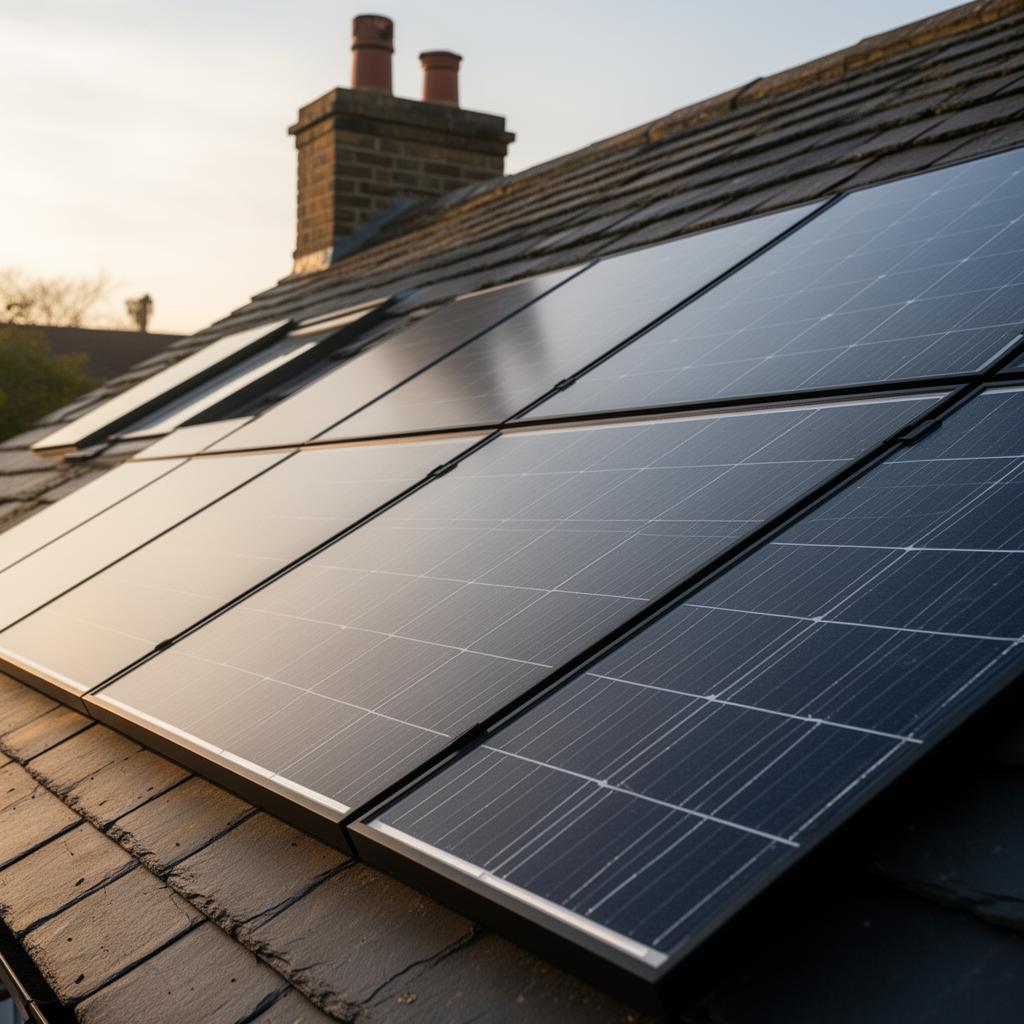
When homeowners plan a solar installation, they often want to maximise the number of panels on their roof to generate as much electricity as possible. But are there legal limits on how many panels you can install? The answer involves permitted development rules, DNO (Distribution Network Operator) notification thresholds, and planning restrictions in certain areas. This guide explains the maximum solar panels UK homes can legally install, the rules you need to follow, and when you might need to apply for planning permission.
How Many Solar Panels Can You Put on a UK Home?
Most UK homes can legally install between 12 and 16 solar panels under permitted development rights, which allow systems that do not protrude more than 200mm from the roof surface and do not extend above the highest part of the roof. There is no fixed wattage cap for domestic installations, but panels must not face a highway on a listed building or in a conservation area without planning permission.
In practice, the number of panels you can fit depends on your roof area, orientation and any shading. A typical 3-bedroom semi has around 30m² of south-facing roof, enough for a 4 kW system of roughly 10 panels. Larger detached homes with dual-aspect roofs can accommodate 16 to 20 panels (6 to 8 kW) without planning consent, provided they meet permitted development conditions.
Permitted Development Rules for Roof-Mounted Solar Panels
In England, solar panels installed on the roof of a house are generally classed as permitted development, meaning you do not need planning permission. However, this is subject to specific conditions.
- Panels must not protrude more than 200mm from the roof plane (measured perpendicular to the roof surface)
- Panels must not be higher than the highest part of the roof (excluding the chimney)
- On a flat roof, the highest point of the panel framework must not exceed 1 metre above the highest part of the roof (not including the chimney)
- Panels should not be installed on a wall or roof that fronts a highway if the property is in a conservation area or World Heritage Site
- Panels must not be installed on a listed building without listed building consent
Critically, there is no numerical limit on the number of panels you can install under permitted development. The constraints relate to how the panels sit on the roof (the 200mm protrusion rule and the height rule), not how many you put up. In theory, you could cover your entire south, east, and west roof faces with panels and still be within permitted development, provided the protrusion and height conditions are met.
Conservation Areas and Listed Buildings
Properties in conservation areas face additional restrictions. Solar panels are generally permitted on conservation area properties but only on roof faces that do not front a highway. This means you can install panels on the rear or side roof slopes without planning permission, but panels visible from the street on the principal elevation may require a planning application.
For listed buildings, you need listed building consent for any solar panel installation regardless of where on the building they are placed. The local planning authority will assess whether the panels would harm the building’s special architectural or historic interest. Some applications are approved with conditions about panel colour, mounting method, and reversibility.
Areas of Outstanding Natural Beauty (AONB), national parks, and the Norfolk Broads have the same restrictions as conservation areas under permitted development rules.
Ground-Mounted Solar Panel Rules
Ground-mounted solar panels have separate permitted development conditions:
- The array must not exceed 9 square metres in total area
- No part of the installation can be more than 4 metres high
- It must be at least 5 metres from the property boundary
- It must not be in a conservation area, AONB, or similar designated land
- Only one ground-mounted standalone installation is permitted per property
The 9 square metre limit equates to roughly 4-5 standard solar panels, which would produce about 1.6-2 kW. For larger ground-mounted arrays, you will need a planning application. These are generally straightforward for domestic properties but add time and cost (typically £200-£400 for the planning application fee and supporting documents).
Importantly, you can have both roof-mounted and ground-mounted panels. The permitted development allowances are separate, so a full roof array plus a small ground-mounted system is perfectly legal without planning permission.
Maximum System Size: DNO Notification Thresholds
While planning law does not limit the number of panels, the electricity distribution network does impose practical limits on system size. These are managed by your Distribution Network Operator (DNO) and relate to how much power you can export to the local grid.
Systems up to 3.68 kW (single phase)
For single-phase supplies (the majority of UK homes), systems up to 3.68 kW can be connected under the G98 process, which is a simple notification. Your installer submits the notification to the DNO, and connection is automatic. There is no DNO approval needed, just a notification after installation.
Systems from 3.68 kW to 16 kW (single phase)
Systems larger than 3.68 kW on a single-phase supply require a G99 application, which is submitted to the DNO before installation. The DNO assesses whether the local network can accommodate the export and may approve, approve with conditions, or request a network study. The G99 process typically takes 4-12 weeks and is usually free for domestic installations up to 16 kW.
Most residential G99 applications for systems up to 6-8 kW are approved without issue. Larger systems or properties in areas with existing network constraints may require export limitation, where the inverter is programmed to cap export at a specified level even though the panels can generate more.
Three-phase properties
Properties with a three-phase electricity supply can connect systems up to 11.04 kW under the simpler G98 notification process (3.68 kW per phase). Systems above this require G99 approval. Three-phase supplies are more common in rural properties, larger homes, and those with existing high-demand electrical installations.
What Is the Practical Maximum for a UK Home?
For most UK houses, the practical maximum is determined by roof space rather than regulation. A standard three-bedroom semi-detached house with a south-facing roof might accommodate 10-14 panels (4-6 kW). A larger detached house with multiple suitable roof faces could fit 20-30 panels (8-12 kW).
| Property Type | Available Roof Space | Typical Maximum Panels | System Size |
|---|---|---|---|
| Terraced house | 15-25 m2 | 8-12 panels | 3-5 kW |
| Semi-detached | 20-35 m2 | 10-16 panels | 4-7 kW |
| Detached bungalow | 30-50 m2 | 14-24 panels | 6-10 kW |
| Detached house | 30-60 m2 | 14-28 panels | 6-12 kW |
| Large detached | 50-80+ m2 | 24-40+ panels | 10-16+ kW |
Panels are typically around 1.7 m2 each, though sizes vary by manufacturer. Modern 400-430W panels mean you get more power from fewer panels than older 250-300W models, making the most of limited roof space.
G99 Applications for Larger Systems: What to Expect
If you want a system larger than 3.68 kW (which most households should aim for if roof space allows), your installer will handle the G99 application on your behalf. Here is what the process involves:
- Your installer submits the application form to the DNO with your system details
- The DNO checks the local network capacity and transformer loading
- A decision is issued within 45 working days (often sooner)
- Approval may come with conditions, typically export limitation if the local network is constrained
- Installation proceeds once approval is received
Export limitation does not mean wasted energy. Your system can still generate its full capacity for self-consumption and battery charging. Only the amount exported to the grid is capped. With a battery and good self-consumption habits, export limitation has minimal impact on your savings.
To find out how many panels your roof can accommodate and what size system makes financial sense for your household, get a free quote from MCS-certified installers who will assess your property.
Frequently Asked Questions
Do I need planning permission for solar panels on a flat roof?
Solar panels on a flat roof are permitted development as long as the highest point of the panel and its mounting does not exceed 1 metre above the highest part of the roof. The panels do not need to be invisible from the street, but they must meet the height condition. In conservation areas, the same highway-facing restriction applies as for pitched roofs.
Can I install solar panels on east and west facing roofs?
Yes. East and west facing panels generate around 15-20% less annually than south-facing, but they produce electricity more evenly across the day. An east-west split system can actually improve self-consumption because morning generation from east-facing panels and afternoon generation from west-facing panels better match typical household demand patterns.
What happens if I install panels without the required G99 approval?
Installing a system above 3.68 kW without G99 approval is a breach of the electricity distribution code. The DNO can require you to disconnect the system until approval is granted, and your installer’s MCS certification could be at risk. Always ensure the G99 process is completed before installation begins. A reputable MCS-certified installer will handle this as part of the project.
Is there a maximum system size for domestic properties?
There is no hard legal cap on domestic system size. However, systems above 50 kW enter a different planning and connection regime typically used for commercial installations. For residential properties, the practical limit is usually the available roof space and the DNO’s network capacity. Systems up to 16 kW are straightforward for domestic G99 applications, and larger systems are possible with additional network assessment.
Do the rules differ in Scotland and Wales?
Permitted development rules vary slightly between England, Scotland, Wales, and Northern Ireland. The principles are similar, but the specific conditions (protrusion limits, conservation area rules) may differ. Scotland, for example, has its own General Permitted Development Order. Always check the specific rules for your nation, or ask your solar panel installer to confirm permitted development status for your property.
See what these numbers mean for your home
Free instant estimate — costs, savings, payback and grants for your region.

Related Articles
Is Solar Battery Storage Worth It in 2026?
Solar panels are now a common sight on UK rooftops, but the real game-changer in 2026 is battery storage. A home battery lets you store the electricity your panels generate…
2 June 2026
Why Spring Is the Perfect Time to Install Solar Panels
If you have been thinking about solar panels for a while but never quite pulled the trigger, spring is the moment to act. The combination of lengthening days, mild installation…
23 April 2026
How the Energy Price Cap Affects Heat Pump and Solar Panel Payback
See how the energy price cap affects heat pump and solar panel payback periods. Real calculations using current UK unit rates show why investing now locks in stronger returns.
15 April 2026