How to Use Your Heating Controls Properly: A Visual Guide
An estimated 80% of UK households have their heating controls set incorrectly, according to energy industry data. Across Lancashire, that translates to hundreds of thousands of homes wasting between £100 and £300 per year simply because the thermostat, programmer, or radiator valves are not being used properly. The good news is that fixing this costs nothing at all – it just takes 15 minutes of understanding how your controls actually work.
How to Use Your Heating Controls Properly
- Set your room thermostat to 18°C–21°C — the World Health Organisation recommends 18°C minimum; each degree above costs roughly 10% more on your heating bill
- Programme your timer for two heating periods — set it to come on 30 minutes before you wake and 30 minutes before you return home, and off 30 minutes before you leave and before bed
- Turn TRVs down in rooms you use less — set bedrooms and spare rooms to 2 or 3 and living areas to 3 or 4 to avoid heating empty spaces
- Never cover your room thermostat — curtains, furniture or draughts near the thermostat cause inaccurate readings and overheating
- Use the frost protection setting when away — this keeps your home above 5°C to prevent frozen pipes without running the heating fully
- Check your boiler flow temperature — reducing it to 55°C–60°C for a condensing boiler improves efficiency by up to 8% without noticeably affecting comfort
Research by the Energy Saving Trust shows that using heating controls correctly saves the average UK household £70 to £150 per year. Many homeowners leave their thermostat set too high or run the heating on a continuous timer rather than programming it around their routine. If your boiler has a built-in flow temperature dial, turning it down from the default 80°C to 55°C is one of the most effective free changes you can make.
The Three Controls You Need to Understand
Most gas-heated Lancashire homes have three separate heating controls, and they need to work together. Think of them as a team: the programmer decides when the heating comes on, the thermostat decides when it turns off, and the thermostatic radiator valves (TRVs) decide which rooms get how much heat. Getting any one of these wrong undermines the others.
The most common mistake I see in homes across Preston, Lancaster, and the Manchester suburbs is setting the programmer and thermostat in conflict. If your programmer turns the heating on at 6am but your thermostat is set to 25 degrees, the boiler will run almost continuously to reach that temperature – burning far more gas than necessary. Understanding each control’s role is the first step to cutting your bills.
Your Room Thermostat: Setting It Right
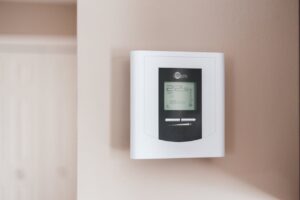
The room thermostat controls the overall temperature of your home. It measures the air temperature wherever it is located and tells the boiler to fire when the temperature drops below its setting, and to switch off once the target is reached. Most thermostats are located in the hallway, though newer wireless models can be placed in the main living area.
The recommended setting is between 18 and 21 degrees Celsius. For most Lancashire households, 19-20 degrees provides a comfortable balance between warmth and economy. Every degree above 20 adds roughly 10% to your heating bill. A household spending £1,000 per year on gas could save an estimated £100 simply by turning the thermostat down from 22 to 20 degrees.
A common misunderstanding: turning the thermostat up to 25 does not heat your home faster. The boiler works at the same rate regardless of the thermostat setting. Setting it to 25 simply means the boiler runs for longer, overshooting your comfort temperature and wasting energy. Set it to the temperature you actually want and leave it there.
Your Programmer or Timer: Getting the Schedule Right
The programmer sets when your heating (and usually hot water) switches on and off. Most modern programmers allow at least two on-off periods per day, and better models allow different schedules for each day of the week.
A sensible heating schedule for a typical Lancashire household where everyone is out during the day might look like this: heating on at 6:00am, off at 8:30am, on again at 4:00pm, off at 10:00pm. If you work from home – increasingly common across Greater Manchester since 2020 – you might want heating on at 6:30am and off at 10:00pm with a single continuous period, but with the thermostat set slightly lower during working hours when you are typically wearing indoor clothes and less active.
The key principle: set the heating to come on 30 minutes before you need the house warm, and turn it off 30 minutes before you go to bed or leave. Your home retains heat for a while after the boiler switches off, so you do not need the heating running right up until you leave or fall asleep. This simple adjustment can shave 60-90 minutes of unnecessary boiler run-time per day.
If your programmer has a “constant” or “on” override mode, use it only when you genuinely need heating all day. Leaving it on constant with a low thermostat setting is a common but wasteful strategy. It is almost always cheaper to use the timed programme properly.
Thermostatic Radiator Valves: Room-by-Room Control
Thermostatic radiator valves (TRVs) are the numbered dials on the side of most radiators. They control the temperature of individual rooms by restricting the flow of hot water to that radiator. The numbers typically run from 0 (off) to 5, with each number representing roughly 4 degrees. Setting 3 equates to approximately 20 degrees in most models.
The mistake most people make is setting all TRVs to the same number. Different rooms need different temperatures. Here is a practical guide for a typical Lancashire home.
- Living room and kitchen: setting 3-4 (roughly 20-24 degrees)
- Bedrooms: setting 2-3 (roughly 16-20 degrees – most people sleep better in cooler rooms)
- Hallway: setting 2 (roughly 16 degrees – just enough to prevent cold draughts)
- Bathroom: setting 3-4 (warm for comfort when using it)
- Spare bedrooms or rooms not in regular use: setting 1 or frost protection (roughly 12 degrees – enough to prevent damp and frost damage without heating an empty room)
Important: do not put a TRV on the radiator in the same room as your main thermostat. If the TRV restricts heat in that room, the thermostat will think the whole house is cold and keep the boiler running, overheating every other room. The radiator in the thermostat room should either have no TRV or have it set to maximum.
Smart Thermostats: Are They Worth the Upgrade?
Smart thermostats like Hive, Nest, Tado, and Drayton Wiser have become popular across Lancashire. They offer several advantages over traditional controls: smartphone control, learning algorithms that adapt to your routine, geolocation features that reduce heating when nobody is home, and energy usage reports that help you understand your consumption patterns.
A smart thermostat costs between £150 and £250 including professional installation. independent energy organisations estimates that a properly used smart thermostat can save around £75-100 per year compared to a traditional programmer and thermostat. So the payback period is typically 2-3 years, with savings continuing for the life of the device.
The most valuable feature for many Lancashire homeowners is zone control. Systems like Tado and Drayton Wiser replace your TRVs with smart radiator valves, allowing you to control each room individually from your phone and set different temperatures for different times of day in each room. This is particularly useful in larger homes around the Fylde coast, Ribble Valley, or South Manchester where some rooms are rarely used.
However, a smart thermostat is only as effective as the person using it. If you set it up and then override it constantly, or set comfort temperatures too high, you will not see meaningful savings. The technology helps, but understanding the principles above matters more than the gadget itself.
Boiler Flow Temperature: The Hidden Setting
There is one more control that most Lancashire homeowners never touch: the boiler flow temperature. This is the temperature of the water your boiler sends to the radiators, typically set at the factory to 70-80 degrees. For a condensing boiler (any boiler installed after 2005), reducing this to 55-60 degrees can save 6-8% on your gas bill without any noticeable difference in comfort.
The reason is technical but simple: condensing boilers only condense (and therefore operate at their advertised 90%+ efficiency) when the return water temperature is below 55 degrees. If the flow temperature is set too high, the return water stays above this threshold and the boiler operates at a lower efficiency of around 80-85%. Turning down the flow temperature forces the boiler into its condensing range more often.
The flow temperature is usually adjusted on the boiler itself, either through a dial or digital controls. Check your boiler manual or ask an engineer during your next service. For a household spending £900 per year on gas, this single adjustment could save an estimated £55-70 annually – and it takes about 30 seconds.
Putting It All Together
Here is a summary of optimal settings for a typical Lancashire three-bedroom semi using gas central heating. Set the thermostat to 19-20 degrees and place it in your main living area if wireless. Programme heating to come on 30 minutes before you need warmth and off 30 minutes before you leave or sleep. Set TRVs individually: living areas at 3-4, bedrooms at 2-3, unused rooms at 1. Reduce your boiler flow temperature to 55-60 degrees.
Making all of these changes together can realistically save an estimated £150-300 per year on a typical Lancashire gas bill, depending on your starting point. That is a significant saving for adjustments that cost nothing and take less than 15 minutes to implement.
Should I leave my heating on low all day or use the timer?
Use the timer. The idea that it is cheaper to keep heating on low all day is a persistent myth. You lose heat continuously through walls, windows, and the roof, so keeping the heating running when you do not need it simply replaces heat that escapes unnecessarily. Timed heating matched to your actual occupancy pattern is almost always cheaper.
What temperature should I set my thermostat to save money?
Between 18 and 20 degrees for most people. The World Health Organisation recommends a minimum of 18 degrees for healthy adults. If you have elderly residents or young children, 20-21 degrees may be more appropriate. Each degree reduction from your current setting saves roughly 10% on heating costs, so even dropping from 21 to 20 makes a meaningful difference over a full winter.
My TRVs do not seem to work properly. What should I do?
TRV pins can stick, particularly over summer when they are not used. Try removing the TRV head and gently pushing the pin in and out with pliers or by hand. If it moves freely, replace the head and test. If the pin is completely stuck, a new TRV head costs around £8-15 and is a straightforward DIY replacement. If the whole valve body needs replacing, this is a job for a plumber and typically costs £40-80 per radiator.
See what these numbers mean for your home
Free instant estimate — costs, savings, payback and grants for your region.

Related Articles
7 Quick Wins to Cut Your Energy Bills This Summer
Summer might seem like the wrong time to think about energy bills, but it is actually when the smartest homeowners make changes. Lower heating demand means more of your spending…
22 May 2026
The Best Time of Year to Replace Your Boiler (and How to Get the Best Price)
Find out why summer is the best time to replace your boiler in the UK, how to negotiate better prices and what to check before committing to an installation.
9 May 2026
Electric Heating Options Explained: Panel Heaters, Storage Heaters and Infrared
Compare electric heating options for UK homes including modern storage heaters, ceramic panel heaters and infrared panels with running cost breakdowns.
7 May 2026