Can You Get Solar Panels on a North-Facing Roof in Manchester?
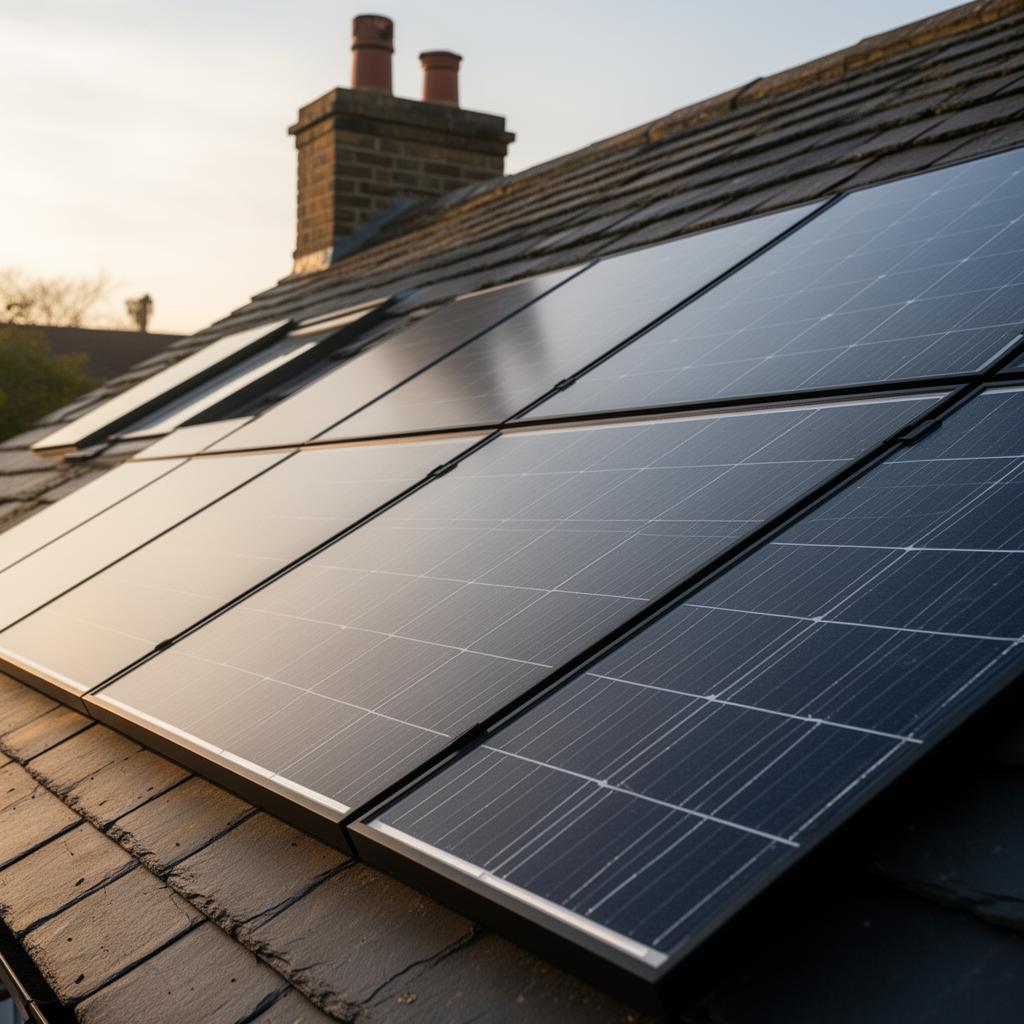
A north-facing roof in Manchester will generate roughly 50-60% of the electricity that an identical south-facing roof produces. That means a 10-panel system that would generate 3,600kWh facing south would produce around 1,800-2,160kWh facing north. It is significantly less, but it is not zero, and in certain circumstances the numbers can still work – particularly if you have high daytime electricity usage, favourable roof pitch, or if you combine north-facing panels with panels on other roof faces.
Can You Install Solar Panels on a North-Facing Roof?
Yes, you can install solar panels on a north-facing roof in Manchester, but they will generate approximately 50 to 60 percent of the output of south-facing panels. A 4kW system on a north-facing roof typically produces 2,000 to 2,200 kWh per year compared with 3,400 to 3,600 kWh on a south-facing roof. This still saves £400 to £550 annually on electricity bills, though the payback period extends from 6 to 7 years to 10 to 13 years.
For Manchester homes with only a north-facing roof, the economics improve significantly if you have a battery to store daytime generation for evening use, or an EV to charge during the day. East and west-facing roof slopes on terraced properties often provide a better compromise, generating 75 to 85 percent of the ideal south-facing output. A reputable MCS-certified installer will model your specific roof orientation and shading to give you accurate generation and savings figures before you commit.
This is one of the most common questions we get from homeowners across Stockport, Tameside, Oldham and other parts of Greater Manchester where row after row of terraced and semi-detached houses have their main roof slope facing north or north-east. Rather than dismissing the idea outright, here is an honest assessment of when north-facing solar works and when it does not.
Why North-Facing Roofs Produce Less
In the UK, the sun tracks across the southern part of the sky throughout the year. South-facing panels catch direct sunlight for the longest period each day, while north-facing panels rely more heavily on diffuse (scattered) light and only get direct sun in the early morning and late evening during summer months when the sun arcs further north.
In Manchester, at latitude 53.5 degrees north, the sun is lower in the sky than in southern England, which makes the orientation penalty slightly worse. However, Manchester also has more overcast days, and on cloudy days the difference between north and south facing panels is smaller because diffuse light comes from all directions equally.
The Numbers: North vs South in Manchester
Here is what a 4kW system (10 panels) would produce annually based on roof orientation in the Manchester area, assuming a typical 35-degree roof pitch:
- Due south: approximately 3,400-3,600kWh per year
- South-east or south-west: approximately 3,100-3,400kWh
- East or west: approximately 2,700-3,000kWh
- North-east or north-west: approximately 2,200-2,500kWh
- Due north: approximately 1,800-2,160kWh
A due-north system produces about 55% of a due-south system. But crucially, the cost of installation is almost the same regardless of orientation – the panels, inverter, scaffolding and labour cost the same. So the payback period on a north-facing system is roughly 75-90% longer than a south-facing one.
When North-Facing Solar Can Still Work
Despite the lower output, there are several situations where installing panels on a north-facing roof makes practical and financial sense:
You have a dual-aspect roof. Many Manchester semis and detached homes have roof slopes facing both directions. If your south-facing slope is small or partially shaded, you can fill it with panels and then add more on the north side to increase your total system size. The north-facing panels will still contribute useful generation, particularly in summer.
Your roof pitch is very low. The steeper a north-facing roof, the worse it performs. But on a nearly flat roof (under 15 degrees), the orientation penalty is much smaller – perhaps only 20-25% less than south-facing. Some modern extensions and dormer roofs in Manchester have low pitches that suit this scenario.
You use a lot of electricity during the day. If someone is home all day (working from home, retired, or running a home business), you will use more of your solar generation directly, which maximises the value of each kWh produced. Even at 55% of south-facing output, a system can offset meaningful amounts of grid electricity.
You want to pair with battery storage. A battery captures surplus generation and lets you use it in the evening. If you are already investing in a battery system, the extra generation from north-facing panels feeds the battery during summer months when production is at its highest.
Electricity prices continue to rise. As electricity gets more expensive, even moderate solar generation becomes more valuable. If electricity rises to 30p per kWh (which some forecasts suggest within a few years), the payback calculation for north-facing panels improves significantly.
When It Does Not Make Sense
There are also clear situations where north-facing panels are not a good investment:
Steep north-facing roofs. If your roof pitch is 40 degrees or more and faces due north, the output drops to barely 45% of south-facing. The financial case becomes very weak with payback periods exceeding 20 years.
Significant shading from north. North-facing panels already receive less direct sun. If there are also trees, buildings or other obstructions to the north, east and west, the output drops further to the point where installation costs cannot be recovered in a reasonable timeframe.
Limited budget. If you can only afford a small system (4-6 panels) and your only option is a north-facing roof, the absolute generation will be too low to justify the installation cost. Better to wait and save for a larger system or explore whether a ground-mounted array in your garden is feasible.
Alternative Options for North-Facing Homes
If your main roof faces north and the numbers do not stack up, consider these alternatives:
Flat roof extensions. Many Manchester homes have single-storey rear extensions with flat or low-pitched roofs. Panels can be mounted on frames tilted to face south on a flat roof, achieving near-optimal performance. This is an increasingly popular option for terraced houses in Levenshulme, Longsight and Gorton.
Garden-mounted panels. If you have a south-facing garden, ground-mounted solar panels are an option – though they typically cost 10-20% more than roof-mounted due to the frame and foundations needed. You also need planning permission for ground-mounted systems.
Solar thermal for hot water only. Solar thermal panels (which heat water rather than generating electricity) can work on east or west-facing roofs and need only 2-3 panels. They provide around 50-60% of a household’s hot water needs and cost £3,000-£5,000 installed.
Prioritise other energy improvements. If solar is not ideal for your roof, investing in insulation, a smart heating system, or LED lighting may deliver better returns. Our guide to energy saving tips for draughty Lancashire cottages covers cost-effective alternatives.
Getting a Proper Assessment
Do not rely on guesswork. A good qualified solar installer will model your specific roof using satellite imagery and shading analysis software. They can give you a precise estimate of annual generation and payback for your exact roof orientation, pitch and shading situation. Get at least three quotes and compare the projected annual generation figures – they should be broadly similar if the installers are using accurate modelling.
If an installer tells you north-facing panels are “just as good as south-facing” or dismisses orientation as unimportant, find a different installer. Equally, if they refuse to consider north-facing panels at all without assessing your specific situation, they may be missing a viable option.
Do north-facing solar panels still qualify for the 0% VAT?
Yes. The 0% VAT on solar panel installations applies regardless of roof orientation. Any residential solar installation qualifies for the VAT reduction until at least March 2027.
Can I get the export tariff with north-facing panels?
Yes. The export tariff pays you for electricity exported to the grid regardless of your panel orientation. Your system needs to be qualified and you need a smart meter, but there is no orientation requirement.
Would an east-west split be better than all north-facing?
If your roof has east and west faces (common on homes where the ridge runs north-south), filling both sides will almost certainly outperform a north-only installation. An east-west split typically produces 80-85% of a south-facing system’s output and spreads generation more evenly across the day.
See what these numbers mean for your home
Free instant estimate — costs, savings, payback and grants for your region.

Related Articles
Is Solar Battery Storage Worth It in 2026?
Solar panels are now a common sight on UK rooftops, but the real game-changer in 2026 is battery storage. A home battery lets you store the electricity your panels generate…
2 June 2026
Why Spring Is the Perfect Time to Install Solar Panels
If you have been thinking about solar panels for a while but never quite pulled the trigger, spring is the moment to act. The combination of lengthening days, mild installation…
23 April 2026
How the Energy Price Cap Affects Heat Pump and Solar Panel Payback
See how the energy price cap affects heat pump and solar panel payback periods. Real calculations using current UK unit rates show why investing now locks in stronger returns.
15 April 2026